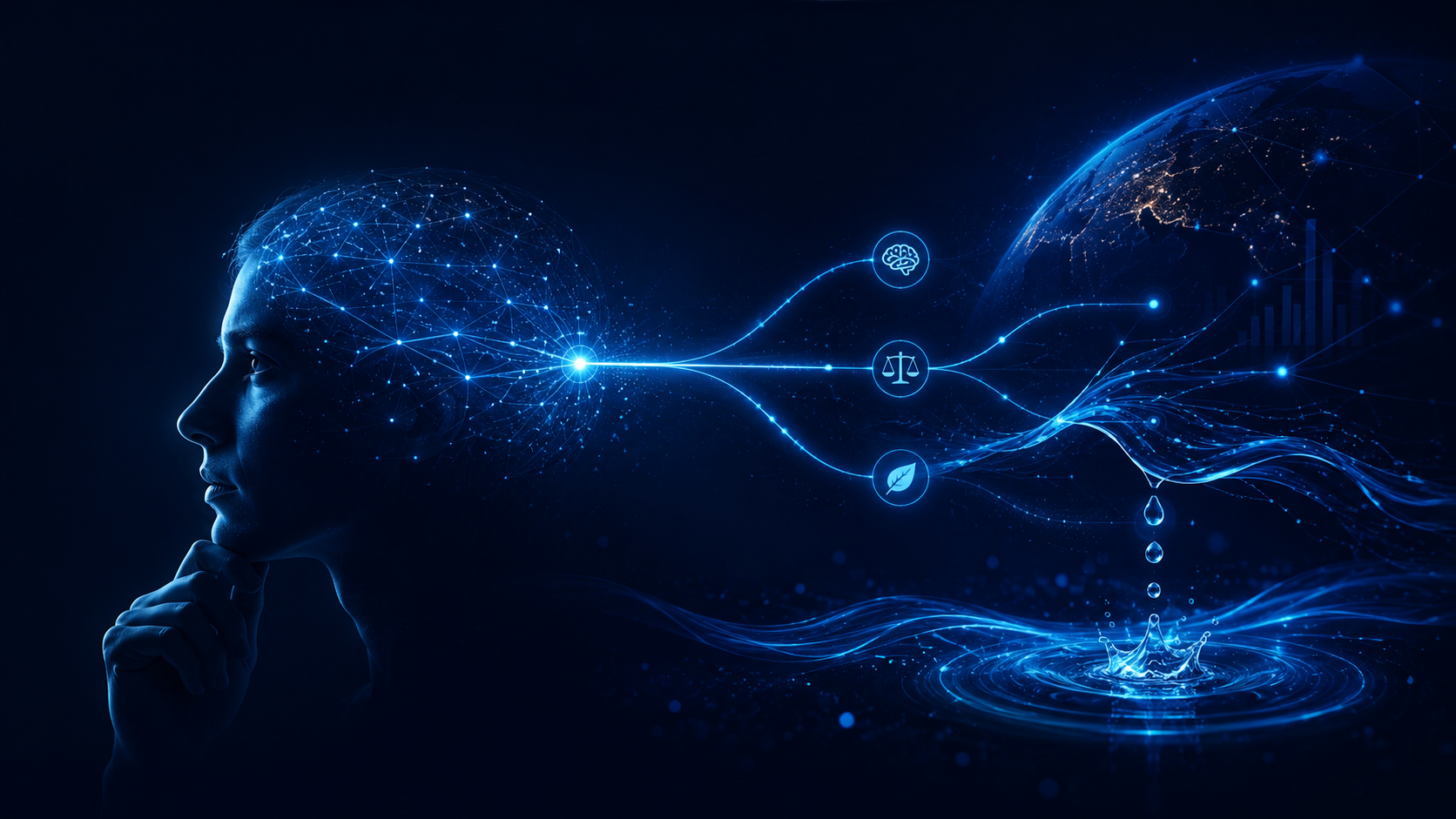
In 2024, Yuval Noah Harari published another fascinating book, Nexus. This Israeli well known writer is widely known for drawing attention to the possibility that humankind may soon no longer be the most powerful force on the planet. As the only rational beings on Earth, we have developed the ability to make decisions on many issues, with all their advantages and drawbacks.
Will AI replace us in this role? Will we benefit from its ability to decide, work, create, and even summarize? How much are we willing to pay for it? Will our lives improve? Or will AI become a valuable tool that frees us from tedious tasks, allowing humans to use that time for their own benefit, such as reading a book and enjoying the sun in the park?
The hidden cost of every prompt
The numbers of the AI's costs are known. A small text of 100 words takes about 0,5 liter of water in National Geographic Portugal (2025) and even if you are polite while you are asking, using words such as please or thank you, the consume of energy will be naturally more. Each word on an IA instruction, is divided in groups of numbers called "token IDs" and sent to huge data centres — some bigger that football pitches — fed by coal or natural gas stations. So, if you think widely, you may imagine the huge amount it takes to get it all going.
Are we ought to humanize IA which does not have feelings? This is completely unnecessary to do so.
Challenge yourself to do a quick research and you'll be amazed maybe even, shocked. Even a simple question takes a relevant amount of an essential element for all the living beings on earth. While the water still runs in the tab, it looks like this is not much of a concern for many people. However, we do not need to be scientists to know that water is a finite natural resource. Without it, all beings will be in danger.
Do we still need to think?
So, we've mentioned the cost of water. Done. What about the skill to think? Do we still need to think? Can we just relax on the coach and have a beer or a cup of tea (your choice) and let AI do things for us? Will we need to think? Will we want to think and discuss, share our opinions based on our readings, experiences and passions? Or did we get to a point where all of that is so old-fashioned that there is no need.
Of course, if we think that AI can and is already doing an extraordinary job in medicine, helping the doctors to deal with diseases diagnosis, treatments or even surgeries with a very low percentage of error. Is it not amazing? Definitely!
If I am asked if I believe that we can live without AI, my truly honest answer will be, no. The tech world has got to a point where there is no return but, will we be naturally intelligent enough to balance the use of this technology?
A divided world, still searching for balance
We are all (well, the so-called civilized world citizens) connected. We all see the news one way or the other. Sometimes, we don't want to see them but that's another issue. The people are more divided than in recent years. They take extreme positions based on some information that they rarely check. That applies to, for example, politics, High Tech and environmental subjects. The natural world has survived and adapted to our way of life multiple times. The natural world has the capacity to find balance and regenerate.
Can we also find a balance in the use of AI for our own sake? No need to ask any artificial intelligence platform to answer that. Ask yourself, look in your mind and soul for the answer. You'll find it.
Artificial intelligence does not exempt us from thinking. On the contrary, it forces us to think better.
Technology only creates value when it solves the right problem.
Binovar helps companies rethink processes, integrate systems, and apply artificial intelligence in a practical, secure, and results-oriented way.
Comments
No comments yet. Be the first!